
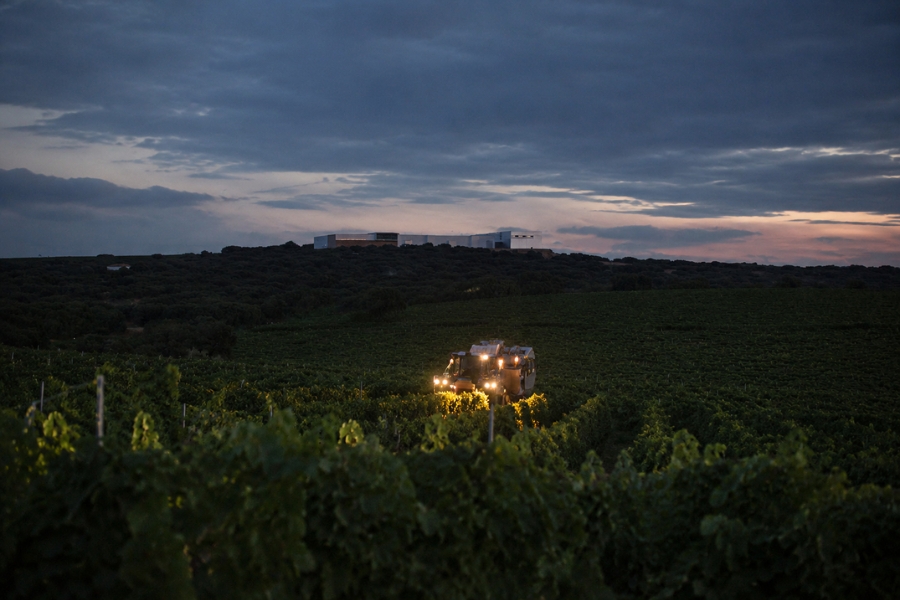
The grape harvest is one of the most important times of the year at a winery. After months of work in the vineyard—monitoring the vines’ development, tending to each plot, and waiting for the optimal ripeness—the time comes to harvest the grapes. However, not all harvests are the same. In some regions and for certain styles of wine, night harvesting has become an essential practice for preserving grape quality, improving efficiency in the winery, and reducing energy consumption.
In Familia Martínez Bujanda, where winemaking always begins with the estate’s own vineyards and a philosophy rooted in respect for the terroir, night harvesting is an integral part of their approach to wine. It’s not just about picking the grapes at night, but about making precise decisions to ensure that each cluster arrives at the winery in the best possible condition.
What is night harvesting, and why is it done?
Night harvesting involves picking the grapes at night or in the early hours of the morning, when temperatures are lower. This temperature difference compared to daytime is key, especially in areas where heat can accelerate the oxidation of the grapes or cause unwanted fermentation before the fruit reaches the winery.
When harvesting at night, the grapes arrive at the winery in a cooler state. This allows for greater precision in the winemaking process, better preservation of primary aromas, and reduces the need to artificially chill the grapes or must. For this reason, night harvesting is particularly beneficial for producing white and rosé wines, as well as wines where the goal is to preserve freshness, aromatic expression, and balance.
Why It’s Important to Harvest Grapes at Night
The temperature of the grapes at the time of harvest directly influences their subsequent behavior. When the grapes arrive at the winery at a high temperature, the risk of oxidation increases and it becomes more difficult to control the winemaking process. In contrast, when harvested at a naturally cool temperature, the fruit better retains its integrity, allowing winemaking to begin under more favorable conditions.
Among the main advantages of nighttime harvesting are:
- Preserving flavors. When harvested while still cool, the grapes better retain their varietal and fruity nuances, which is essential for aromatic varieties and high-quality white wines.
- Reducing oxidation. Heat promotes reactions that can affect the wine’s color, aroma, and clarity. Nighttime harvesting helps minimize this risk from the very beginning.
- Energy efficiency. If the grapes enter the winery at a lower temperature, less energy is needed to lower their temperature. This results in savings in cooling capacity and is consistent with more sustainable viticulture.
- Improving Work in the Winery. A more stable raw material allows for greater precision in production and enables technical decisions to be made from a more controlled starting point.
Nighttime Grape Harvest at the Martínez Bujanda Family: Sustainability and Vineyard Care
As part of a philosophy that emphasizes vineyard care, night harvesting is carried out at both Finca Montepedroso and Finca Antigua—two projects where environmental conditions, the type of wine, and a commitment to sustainability make harvesting at night a very logical choice.
Finca Montepedroso
At Finca Montepedroso, located in the municipality of Rueda, Valladolid, the nighttime harvest reflects both the region’s tradition and the needs of a variety as expressive as Verdejo. The estate has 25 hectares of vineyards dedicated exclusively to this grape, in a setting located at an altitude of 750 meters and characterized by stony soils.
Finca Montepedroso rounds out its commitment to sustainability with solar energy self-sufficiency, rainwater harvesting, and a winery that blends into the landscape, leaving virtually no environmental footprint. In addition, it practices sustainable viticulture, with zero pesticide and heavy metal residues, and is moving toward 100% organic harvesting.
Finca Antigua, located in Los Hinojosos, in Cuenca, is another outstanding example of night harvesting within the Martínez Bujanda family. It is a 1,000-hectare estate, with 421 hectares of vineyards and the remainder consisting of Mediterranean scrubland, situated at an elevation of 900 meters.

Finca Antigua
This practice is part of a broader sustainability strategy at Finca Antigua, which includes organic farming, the use of solar panels, the optimization of water consumption through nanotechnology, the effective use of the winery’s architecture, and the reuse of resources from the vineyard. Harvesting at night is not an isolated action, but rather another component of a working model focused on caring for the environment and improving the quality of the wines.

A technical decision that affects quality
Nighttime harvesting demonstrates that wine quality begins long before fermentation. It starts in the vineyard, with careful observation of each plot and the selection of the exact moment for harvest. At Familia Martínez Bujanda, this practice reflects a way of working in which tradition, innovation, and sustainability go hand in hand.